
Ceiling Water Damage & Wet Drywall Cleanup in Lakeland, FL
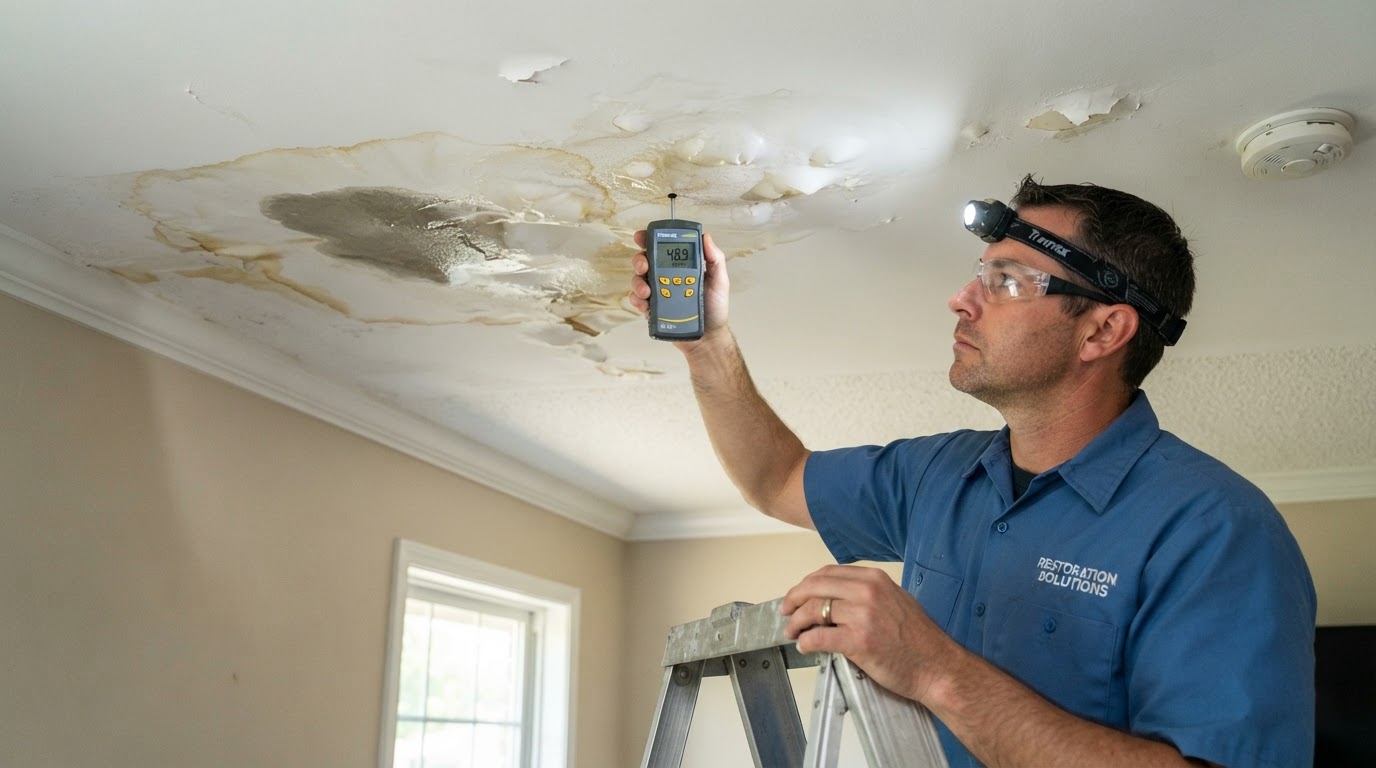
Ceiling water damage and wet drywall cleanup is the moisture assessment and structural drying work that follows water entering a ceiling assembly from above. In Lakeland, FL, ceiling water damage can result from a roof leak, a plumbing leak on an upper floor, an upstairs bathroom leak, an HVAC condensate problem, an appliance leak above, or storm water intrusion. Because water follows framing and gravity, it often appears as brown or yellow staining, bubbling paint, soft drywall, or sagging far from the actual source. This page is about the water that entered the ceiling and drywall, not the roof or plumbing repair itself. Lakeland Water Damage Restoration provides moisture assessment, drying, and water damage cleanup for properties across Lakeland and Polk County. Call (863) 614-1214 to discuss cleanup assistance.
Warning Signs of Ceiling Water Damage
Ceiling water damage is usually discovered through its signs rather than through active dripping. A stain, a patch of bubbling paint, or a soft spot in the drywall can indicate moisture that has been traveling through the ceiling assembly for some time. Because water follows framing and gravity, the visible sign frequently appears far from the source, which is why moisture assessment is used to determine the full extent of affected materials.
Brown & Yellow Staining
Brown or yellow stains are the most common sign of water that has entered the ceiling drywall, deposited minerals, and dried, often appearing far from the actual source.
Bubbling & Peeling Paint
Bubbling or peeling paint indicates moisture trapped behind the paint film, which breaks its bond with the drywall surface even when the ceiling otherwise appears dry.
Soft or Sagging Drywall
Soft drywall and sagging indicate that the gypsum core has absorbed enough water to lose structural integrity. A sagging ceiling should be treated with caution, as it may hold trapped water.
Dripping & Damp Odors
Active dripping, a damp or musty odor, and recurring stains that return after drying all suggest ongoing moisture in the ceiling assembly that has not been resolved.
Recurring Stains
A stain that returns after it has dried indicates that the source of the water is still active, even if the leak is intermittent or only appears during rain.
Common Sources Above
Roof leaks, plumbing leaks on an upper floor, upstairs bathroom leaks, HVAC condensate problems, appliance leaks above, and storm water intrusion can all send water into a ceiling.
Is a water-stained ceiling still wet after the stain stops growing?
Not necessarily. A ceiling stain stops growing when the water source stops or dries, but the drywall, insulation, and framing above can still hold moisture. Appearance alone cannot reliably confirm whether the ceiling is dry, because water can remain trapped in the assembly after the visible stain has stopped spreading. Moisture meters and thermal imaging are used to measure whether materials are still wet, since a dry-looking surface is not a reliable indicator.
How Wet Ceiling Drywall Responds to Water
Ceiling drywall is made of a gypsum core sandwiched between paper facing, and it responds to water in specific ways. Understanding how water moves through the paper facing and gypsum core helps explain why some ceilings can be dried while others require removal, and why the decision depends on condition, contamination, and structural integrity rather than on the presence of water alone.
Drywall Paper Facing
The paper facing wicks water rapidly across the ceiling surface, spreading moisture beyond the visible stain. Bubbling paint and soft spots in the facing often reveal how far water has traveled.
Gypsum Core
The gypsum core absorbs water and loses structural strength, producing softness and sagging. Heavily saturated gypsum may not recover its integrity and can require removal of the affected section.
Ceiling Insulation
Insulation above the ceiling drywall settles and holds moisture against framing, resisting drying. Depending on the material and condition, wet insulation may require removal rather than in-place drying.
Wood Framing
Wood framing and joists retain moisture after a ceiling leak and can be dried with controlled air movement and dehumidification, returning framing to an appropriate moisture content.
Sagging Ceilings
A sagging ceiling can indicate trapped water above the drywall and should be treated with caution. Standing below visibly unstable ceiling materials is unsafe, and the area should be evaluated before drying proceeds.
Hidden Water Migration
Water follows framing and gravity across a ceiling, so the visible stain often appears far from the source. Moisture detection is used to map the full extent of affected materials beyond the stain.
Key point: Because water migrates through the paper facing, gypsum core, insulation, and framing of a ceiling assembly, the visible stain is rarely the full extent of the loss. Moisture detection across the ceiling is what separates a cosmetic repair from a complete drying project.
Ceiling Materials & Moisture Considerations
A ceiling assembly contains drywall, insulation, and framing, each of which responds to water differently. Understanding how water moves through these materials helps explain why a ceiling stain is rarely the full extent of the loss and why drying often extends into the insulation and framing above.
Coordinate the Source
The source of the water above the ceiling is identified or its repair coordinated, such as a roofing contractor for a roof leak or a plumber for a pipe, so no additional water enters the assembly.
Inspect Visible Damage
Stains, bubbling paint, soft drywall, and sagging are inspected to establish where moisture has become visible and how far it may have spread through the ceiling.
Map Ceiling Moisture
Moisture meters and thermal imaging trace water that has followed framing or insulation across the ceiling, mapping the full extent of affected drywall beyond the visible stain.
Assess Structural Condition
The drywall is evaluated for saturation, softness, sagging, and structural integrity, because a sagging or soft ceiling may hold trapped water and require caution.
Determine Drying vs. Removal
Affected drywall is evaluated to determine whether it can be dried in place or whether damaged sections require removal, based on contamination, saturation, and structural condition.
Dry & Dehumidify
Air movers and dehumidifiers are positioned to dry salvageable materials, with access created where necessary to reach trapped moisture in the ceiling assembly.
Monitor Until Dry
Readings are taken over the drying period to confirm progress and verify that affected materials reach an appropriate dry standard before the ceiling is closed up.
Ceiling Water Damage Cleanup Across Lakeland
Lakeland's heavy rainfall, tropical weather, and high indoor and outdoor humidity all contribute to ceiling water damage, whether from a roof leak, a plumbing leak on an upper floor, or an HVAC condensate problem. Because moisture can persist in a ceiling assembly long after the visible stain has dried, Central Florida's humidity makes controlled dehumidification more important for returning affected materials to an appropriate dry standard. Ceiling water damage cleanup in Lakeland applies the same moisture detection and drying principles whether the source is a roof, a pipe, or an appliance above.
After the source is repaired or controlled, most ceilings still require structural drying to address moisture that has migrated into the drywall, insulation, and framing. Lakeland Water Damage Restoration focuses on the water that entered the ceiling and affected building materials, while a roofing contractor, plumber, or HVAC professional may be needed to correct the source. This page concentrates on ceiling and wet drywall cleanup specifically; the broader roof, ceiling, wall, and hidden water damage page covers concealed moisture throughout the property. Related services such as structural drying, roof leak water damage cleanup, and storm water damage restoration are often part of the same project. Service-area pages are also available for surrounding communities across Polk County and Central Florida through our Service Areas section.
Ceiling Water Damage Questions & Answers
What causes ceiling water damage?
Ceiling water damage is caused by water entering the ceiling assembly from a roof leak, a plumbing leak on an upper floor, an upstairs bathroom leak, an HVAC condensate problem, an appliance leak above, or storm water intrusion. The water wets the drywall and insulation and produces a visible stain as it dries. The stain often appears far from the source because water follows framing and gravity.
Can wet ceiling drywall be dried?
Wet ceiling drywall can sometimes be dried in place when the water is from a clean source, the material is structurally sound, and effective drying can be achieved. The decision depends on contamination, saturation, duration, and structural condition. If the drywall is soft, sagging, contaminated, or cannot be effectively dried, affected sections may need removal.
Why is my ceiling turning brown?
A ceiling turns brown when water enters the drywall and deposits minerals, tannins, or rust from the building materials as it dries, leaving a yellow-brown stain. The stain often appears far from the actual source because water follows framing and gravity across the ceiling. A recurring or growing stain indicates that the source is still active.
Is a sagging wet ceiling dangerous?
A sagging wet ceiling can be dangerous because it may hold trapped water above the drywall and could release unexpectedly. Standing directly below visibly unstable ceiling materials is unsafe. The area should be cleared and evaluated by a professional before drying or removal proceeds, especially if the sagging is significant or growing.
Can water travel across a ceiling?
Yes. Water follows the path of least resistance along framing, the drywall paper facing, and insulation, so it can travel across a ceiling and produce a stain far from where it entered. A leak near the roofline can produce a ceiling stain in the middle of a room. Moisture mapping is used to trace these paths and locate the full extent of affected materials.
How do you locate the source of ceiling moisture?
The source of ceiling moisture is located by tracing the water path with moisture meters and thermal imaging, combined with identifying the likely source above, such as a roof leak, plumbing, bathroom, or HVAC condensate. Because water travels along framing, the visible stain is often not directly below the source. A roofing contractor, plumber, or HVAC professional may be needed to confirm and repair the source.
Can an upstairs bathroom leak damage a ceiling?
Yes. An upstairs bathroom leak allows water to travel through the floor assembly and appear as staining, sagging, or dripping in the ceiling of the room below. The ceiling drywall, insulation, and framing between the floors can all hold moisture, so drying often requires addressing the lower ceiling as well as the bathroom itself.
How long can drywall stay wet?
Drywall should be dried as soon as it is practical to do so. The longer it remains wet, the more structural strength it loses and the greater the risk of secondary damage. Prolonged dampness can increase the potential for microbial growth. Drying time varies based on saturation, humidity, airflow, and how quickly mitigation begins.
Does insurance cover ceiling water damage?
Coverage depends on the source of the water, policy terms, exclusions, endorsements, and the insurer's determination. A sudden leak is often handled differently than a slow leak that developed over time, and the length of time the damage existed can affect coverage. Property owners should review their policy and speak with their insurance carrier about the specific loss.
Wet Ceiling or Water-Stained Drywall in Your Lakeland Home?
Call Lakeland Water Damage Restoration at (863) 614-1214 to discuss moisture assessment, drying, and water damage cleanup for your ceiling. You can also submit a service request below and our team will follow up.
Call (863) 614-1214Lakeland, FL 33810 • Serving Polk County & Central Florida
Request Ceiling Water Damage & Wet Drywall Cleanup Service
Submit your details or call our Lakeland team directly.