Dishwasher Overflow & Hardwood Floor Water Damage Cleanup in Lakeland, FL
Dishwasher overflow and hardwood floor water damage cleanup is the water extraction, moisture assessment, and structural drying work that follows a dishwasher leak or overflow that releases water onto hardwood flooring. In Lakeland, FL, water from a dishwasher supply hose, drain hose, or overflow can spread across hardwood flooring, seep between board joints, and migrate into the subfloor beneath before the damage is visible. Because hardwood absorbs water and distorts, prompt extraction and drying can influence whether boards can be saved. Lakeland Water Damage Restoration provides water extraction, moisture assessment, and structural drying for hardwood floor water damage across Lakeland and Polk County. Call (863) 614-1214 to discuss cleanup assistance.
What Causes Dishwasher Water on Hardwood & Warning Signs
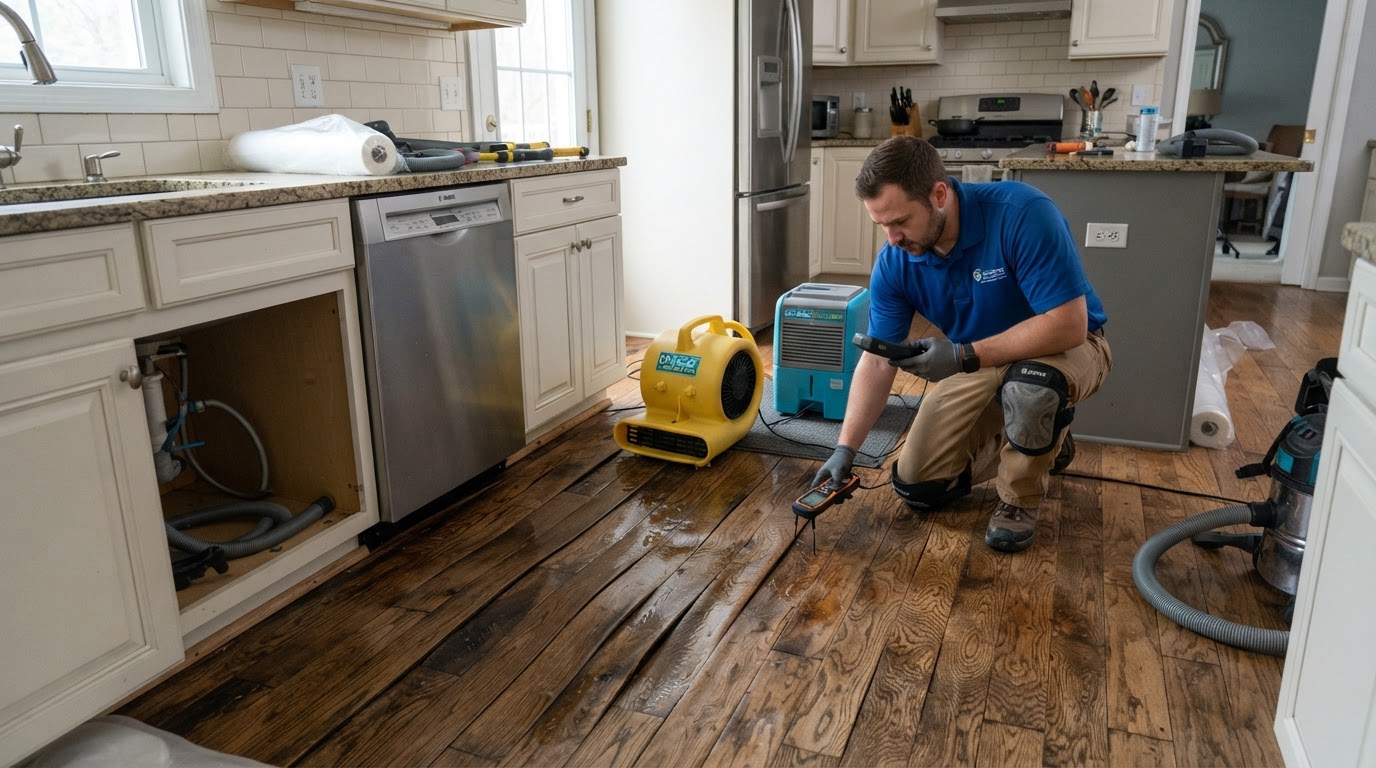
Dishwashers sit at the edge of kitchen flooring, so a leak or overflow can release water directly onto hardwood. Supply hose failures, drain hose leaks, door seal leaks, and overflows can all send water across the floor surface and between board joints. Because hardwood expands when it absorbs water, the first signs of damage are often cupping, crowning, or gaps between boards near the appliance.
Dishwasher Overflow
An overflow or internal cycle malfunction can release water from the dishwasher door or base onto the surrounding hardwood flooring, spreading across the surface and between board joints.
Supply Hose Leak
The braided supply hose connecting the dishwasher to the water line can fail at the connection or along the hose, releasing pressurized water onto the floor beneath and beside the appliance.
Drain Hose Leak
A loose or deteriorated drain hose connection can leak water each time the dishwasher drains, wetting the flooring beneath the appliance and along the cabinet edge.
Door Seal Leak
A worn or damaged door seal can allow water to escape during the wash cycle, running down the front of the appliance onto the hardwood flooring below.
Slow Leak Beneath Dishwasher
A slow leak beneath the dishwasher can wet the subfloor and the underside of hardwood flooring for weeks before cupping or warping becomes visible on the surface.
Warning Signs on Hardwood
Cupping or crowning of boards, gaps between planks, darkening or discoloration near the dishwasher, and a spongy feel underfoot all suggest water has reached the hardwood flooring.
What should I do when dishwasher water gets onto hardwood flooring?
When dishwasher water gets onto hardwood flooring, stop the appliance and shut off its water supply if it can be done safely, and avoid contact between standing water and any electrical components. Remove visible standing water quickly where safe, arrange for appliance or plumbing repair as needed, and contact a water damage restoration provider to assess moisture beneath and within the floor assembly. Prompt extraction and drying can influence whether cupped boards can be saved, so do not delay.
How Hardwood Responds to Water & Hidden Pathways
Hardwood flooring absorbs water through board edges and joints, and the finish layer slows but does not stop moisture from entering the wood. Water that seeps between boards migrates into the subfloor and underlayment beneath, where it cannot evaporate on its own. Understanding how hardwood and the subfloor respond to saturation helps explain why drying extends beneath the surface and why board distortion is only one part of the damage.
Solid Hardwood
Solid hardwood boards absorb water through edges and joints, producing cupping where board edges rise above the center. Prompt drying may allow cupped boards to flatten, but severe buckling or prolonged saturation can require replacement.
Engineered Hardwood
Engineered flooring has a veneer layer over a composite core that can delaminate when saturated. Engineered boards may respond differently than solid hardwood and can lose structural integrity when the core absorbs water.
Board Joints & Finish Layer
Water enters hardwood through board joints and edges where the finish does not protect the wood. The finish slows surface absorption but does not prevent water from seeping between boards into the wood and subfloor beneath.
Subfloor & Underlayment
Water that seeps between boards migrates into the subfloor and underlayment beneath, where it cannot evaporate on its own. Trapped subfloor moisture can require targeted drying or access from beneath the floor assembly.
Cabinets Adjoining Flooring
Water from a dishwasher leak can travel beneath the cabinet edge and wet the cabinet toe kick and subfloor beneath the cabinet, where it remains hidden from the surface.
Cupping, Crowning & Buckling
Cupping occurs when board edges rise, crowning when the center rises, and buckling when boards lift from the subfloor entirely. The degree of distortion influences whether boards can be dried in place or require replacement.
Key point: Because water seeps between hardwood boards into the subfloor and beneath cabinet edges, the visible cupping is often only the surface of a deeper moisture path. Moisture detection across the boards and subfloor is what separates a complete drying project from a surface cleanup.
Hardwood Flooring Materials & Damage Considerations
Hardwood flooring responds to water differently depending on whether it is solid or engineered, how it is installed, and how quickly drying begins. Water that seeps between boards also reaches the subfloor and underlayment beneath, where it cannot evaporate on its own. Understanding these material differences helps explain why some floors can be dried while others require board replacement.
Stop Active Release
The dishwasher is shut off and its water supply is closed, with appliance or plumbing repair arranged to correct the source so no additional water reaches the flooring.
Extract Visible Water
Standing water on the hardwood surface is extracted quickly to limit absorption into board edges and joints, since the longer water sits, the more the wood distorts.
Inspect Around & Beneath
The flooring around and beneath the dishwasher is inspected for water that has seeped between boards, into the subfloor, and beneath adjacent cabinets.
Measure Hardwood Moisture
Moisture meters measure the moisture content of individual boards and the subfloor beneath, mapping how far water has penetrated into the floor assembly.
Check Subfloor & Cabinets
The subfloor beneath the hardwood and the cabinet edges adjoining the flooring are checked for moisture that has migrated beneath the surface.
Establish Controlled Drying
Air movers and dehumidifiers are positioned to evaporate moisture from the hardwood and subfloor, with drying conditions adjusted based on board response and moisture readings.
Monitor Floor Condition
Moisture readings and board condition are monitored over the drying period to track progress and evaluate whether boards are returning toward their original shape.
Dishwasher Hardwood Damage Across Lakeland
Hardwood flooring is common in Lakeland kitchens, where a dishwasher leak or overflow can release water directly onto the wood surface. Because hardwood absorbs water through board joints and Central Florida's humidity slows natural drying, prompt extraction and controlled dehumidification can influence whether cupped boards return toward their original shape. The longer water sits on hardwood, the more the wood distorts, so quick response matters for salvage potential.
After the dishwasher source is repaired, most hardwood floor water damage requires moisture assessment and controlled drying to address water that has seeped between boards and into the subfloor. Lakeland Water Damage Restoration focuses on the water that reached the hardwood and affected building materials, while an appliance technician may be needed to correct the dishwasher failure. This page concentrates on dishwasher water damage to hardwood flooring specifically; the broader dishwasher leak and kitchen water damage page covers general kitchen water losses. Related services such as structural drying, under-sink cabinet cleanup, and emergency water extraction are often part of the same project. Service-area pages are also available for surrounding communities across Polk County and Central Florida through our Service Areas section.
Dishwasher Hardwood Floor Water Damage Questions & Answers
Can dishwasher water ruin hardwood floors?
Yes. Water from a dishwasher leak or overflow seeps between hardwood board joints and is absorbed by the wood, producing cupping, crowning, gaps, or buckling. The extent of damage depends on the water volume, exposure duration, flooring type, and how quickly extraction and drying begin. Prompt response can improve salvage potential, but heavily saturated or buckled boards may require replacement.
What is hardwood cupping after a leak?
Cupping occurs when the edges of individual hardwood boards rise above the center, creating a concave surface. It happens when the underside of the board absorbs more moisture than the top, which is common when water seeps between boards and wets the subfloor beneath. Cupped boards may sometimes flatten with controlled drying if the distortion is not severe.
Can wet hardwood dry in place?
Sometimes. Wet hardwood can sometimes be dried in place using air movers and dehumidifiers if the cupping is mild, the subfloor can be dried, and the boards remain attached. Heavily buckled or delaminated boards that have lifted from the subfloor may require removal and replacement. Each floor is evaluated based on moisture readings and board condition.
How do you know if water reached the subfloor?
Water reaching the subfloor is detected using moisture meters that measure the moisture content of individual boards and the subfloor beneath. Elevated readings beneath the surface, persistent cupping, or a spongy feel underfoot can indicate that water has seeped between boards into the subfloor and underlayment, where it cannot evaporate on its own.
Should hardwood be removed after a dishwasher overflow?
Not always. Whether hardwood should be removed depends on the degree of cupping or buckling, the subfloor moisture, and whether effective drying can be achieved with the boards in place. Mildly cupped boards may be dried in place, while heavily buckled or delaminated boards that have lifted from the subfloor may require removal. Each floor is evaluated based on moisture readings and board condition.
Can water travel beneath cabinets from a dishwasher leak?
Yes. Water from a dishwasher leak can travel beneath the cabinet edge and wet the cabinet toe kick and subfloor beneath the cabinet, where it remains hidden from the surface. Moisture meters are used to detect water that has migrated beneath cabinets and into the subfloor along the cabinet edge.
How long does hardwood take to dry after water damage?
Hardwood drying time varies depending on the water volume, exposure duration, flooring type, subfloor moisture, humidity, temperature, airflow, and how quickly mitigation begins. There is no universal drying time, and moisture readings over the drying period confirm when boards and the subfloor have reached an appropriate dry standard.
Does engineered hardwood respond differently than solid hardwood?
Yes. Engineered hardwood has a veneer layer over a composite core that can delaminate when saturated, while solid hardwood is a single piece of wood that cups or crowns. Engineered boards may lose structural integrity when the core absorbs water and may be less likely to be saved than solid hardwood after significant saturation.
Does homeowners insurance cover dishwasher hardwood floor damage?
Coverage depends on the source of the loss, policy terms, exclusions, endorsements, maintenance conditions, and the insurer's determination. A sudden dishwasher overflow is often handled differently than a slow leak that developed over time, and maintenance-related issues can affect coverage. Property owners should review their policy and speak with their insurance carrier about the specific loss.
Dishwasher Water Damaging Your Lakeland Hardwood Floors?
Call Lakeland Water Damage Restoration at (863) 614-1214 to discuss water extraction, hardwood moisture assessment, and controlled floor drying after a dishwasher leak. You can also submit a service request below and our team will follow up.
Call (863) 614-1214Lakeland, FL 33810 • Serving Polk County & Central Florida
Request Dishwasher Hardwood Floor Damage Cleanup Service
Submit your details or call our Lakeland team directly.